Note names
The note names setting changes how notes are written and read throughout the app. It matters most if you learned music in a tradition that names notes differently.
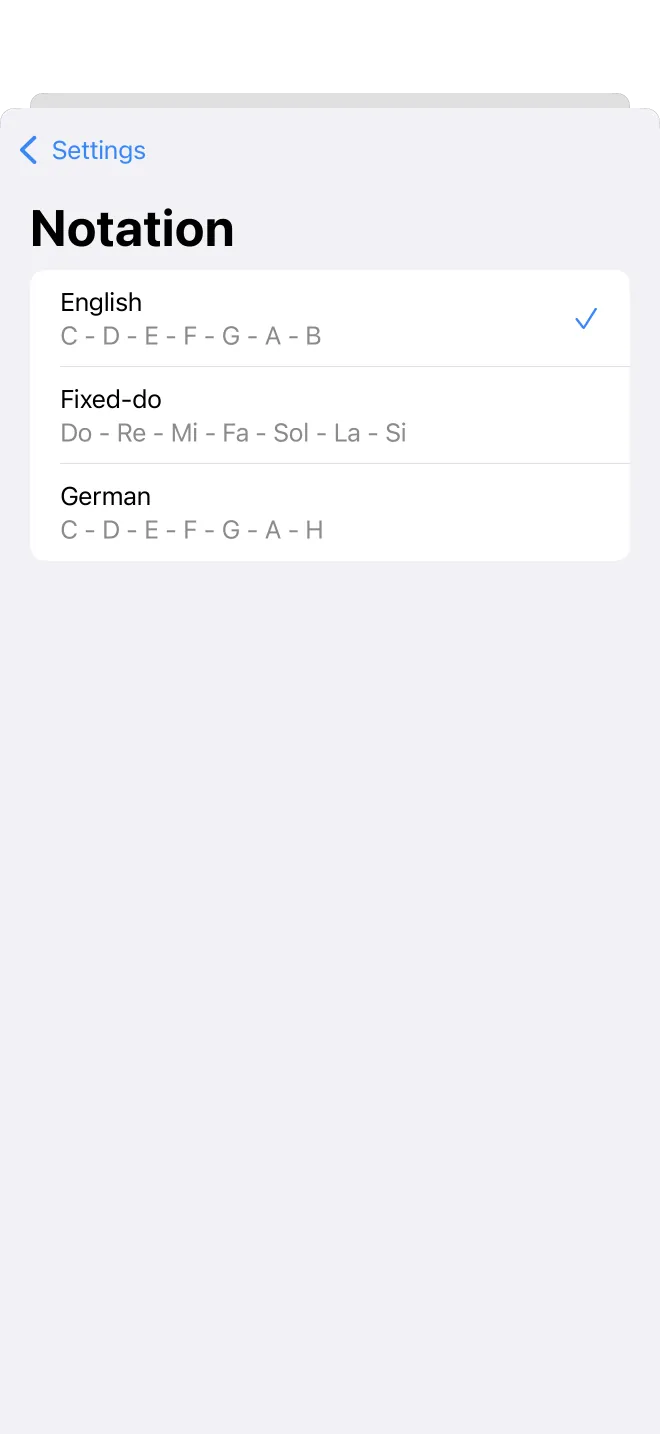
Choosing a notation
Settings, then Notation, offers a few styles, each shown with an example so you can see how your notes will read before you choose. English uses the letters A to G. German uses the same letters but calls B natural H, and B flat B. Neo-Latin uses do, re, mi, fa, sol, la, si. Pick the one you read most easily, and every chord, scale, and staff label follows it.
Why it is here
The same note has different names in different countries. A German musician reads H where an English one reads B. Setting your notation once means the app speaks your language, and the example under each option confirms the change at a glance.